
A Tale of Two Seasons: Quantifying the NBA's Tanking Dilemma
Analyzing the 2025-2026 NBA lottery teams competitiveness to identify trends suggest tanking

The talk of the NBA world in recent days has been the NBA’s tanking problem. Though this is not a new problem, the decisions from this year’s front offices and coaching staffs have produced unseen (and unapologetic) levels of tanking. The trend stepped more into the spotlight as NBA commissioner Adam Silver fined two teams for “conduct detrimental to the league” and addressed the issue at this past weekend’s All-Star Weekend.
From a fan perspective, tanking is usually an unappealing strategy that promotes disengaged attendance and game viewership. However, there is a case for fans to be more understanding of tanking this season. The 2026 draft class is being regarded as one of the best in over a decade, with comparisons to the ‘03 draft class (featuring LeBron James, Dwyane Wade, Carmelo Anthony, and others). As a result, lottery teams that own their own pick in the 2026 draft are making every effort to position themselves in the best possible situation to get a franchise-changing player at best or a young-core addition at worst.
From the NBA league perspective, the problem with tanking is obvious: less money. The NBA has to control teams deliberately tanking to create the best product for their fans and sponsors. Instead of discussing further what those remedies should be, I decided to do some exploratory analysis highlight this year’s tanking trends.
The following sections discuss lottery team competitiveness to date, with a look at some of the trends seen pre- and post-trade deadline.
Competition Metric
While viewing certain regular-season games, it is apparent when teams may not be giving their best to compete. However, perception is often viewed as subjective until a large enough majority agrees (and even then…).
As a result, I used common in-game metrics and player information to analyze the lottery teams’ competitive measure. The following metrics were used:
Win Probability (WP) between 15 - 85 %
Average rotation age per game
Difference in franchise player usage post trade deadline (February 5th, 2026)
Basketball has a large swing in win probability per possession inherently from the weighted context of each possession. As a result, I defined the competitive window to be from 15% to 85% win probability for a given team’s possession. By defining a range for competitive possessions, the goal is to limit possessions in blowouts. In addition, I only looked at possessions in the last 5 minutes of regulation to exclude in-game variability. By looking at only competitive possessions in the last 5 minutes of regulation, one can see how lottery teams perform in the final moments of winnable games. It should be noted that this competition metric relies on teams being competitive entering the final 5 minutes of regulation. As a result, some teams may appear less competitive than they actually are due to earlier execution failures.
With proper context, these trends in the final moments can provide insightful observations on team intentions.
Finishing Out Games
At this point in the season, teams become lottery contenders for two main reasons:
An injury-plagued season for their star player (or multiple players)
The team just isn’t good enough to win games.
Injuries are unavoidable with the current play style and rules in the NBA; however, reason #2 is where the tanking conversations usually start. A poorly constructed team is sometimes intentional by future-facing decisions to improve the team’s chances in years to come.
A poorly constructed roster, however, doesn’t mean a team can’t still be competitive throughout the season (as these are still professional basketball players in the world’s top basketball league). The plot below highlights each lottery team’s ability to finish winnable games. Each team’s plot shows a rolling average win probability through their games up to the All-Star break. For this rolling average, I used an exponentially-weighted moving average to account for recent trends and non-continuous data from the competition criteria specified earlier.
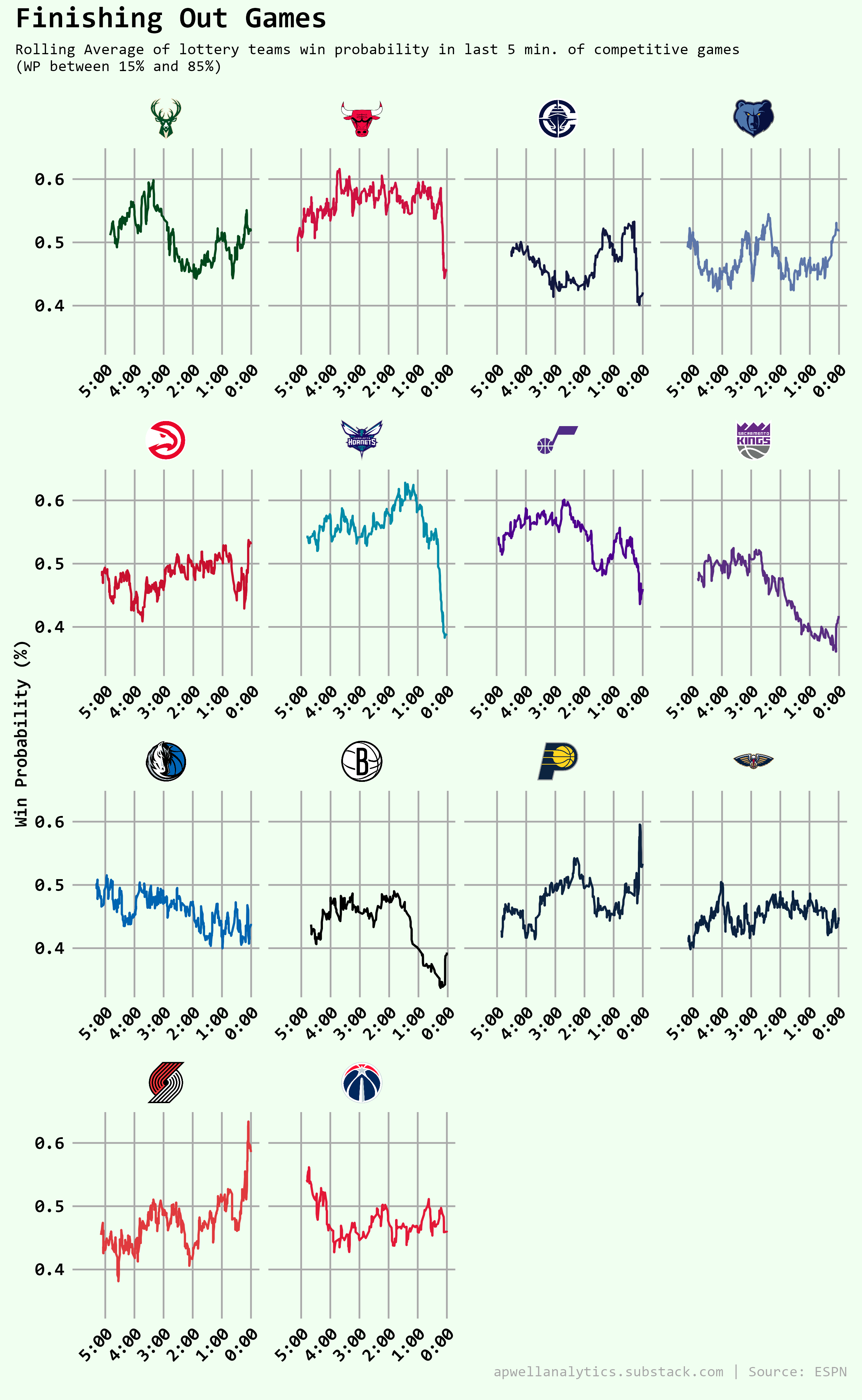
From the plots above, it is apparent that many of the lottery teams have trouble closing out games. Of note, the Nets, Jazz, Kings, Pelicans, and Wizards really struggle to produce competitive possessions in the last 5-minute stretch of regulation. Teams like the Hornets and Bulls appear to struggle in the final few possessions of the game.
From the analysis above, it would be beneficial to see the distribution of competitive possessions for each team, along with their average win probability. The chart below shows the lottery teams’ competitive possession per game, with their average competitive possessions per game and how they compare to non-lottery teams in the NBA.
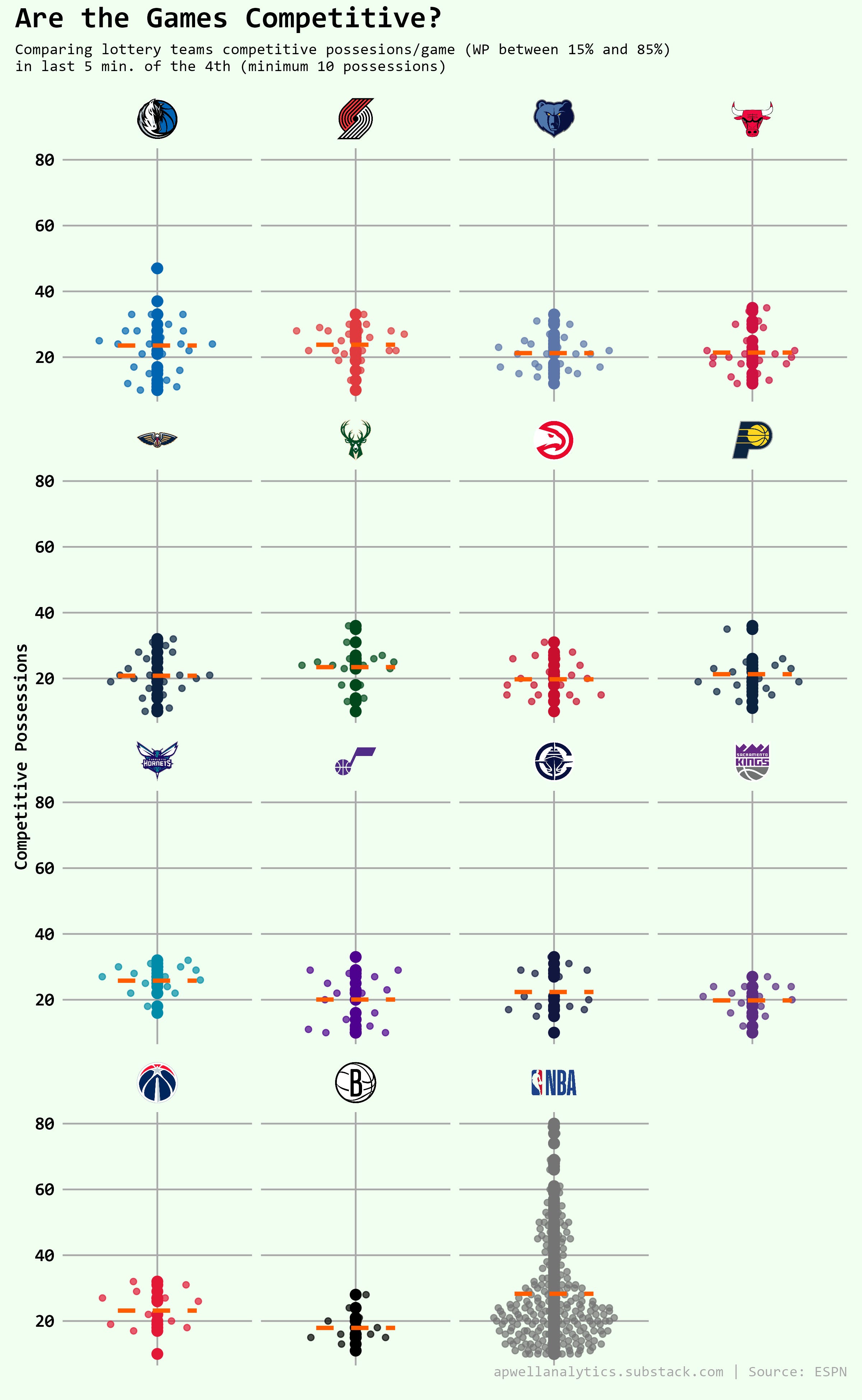
The plot above is ordered by the teams with the most competitive possessions going into the All-Star break. The Dallas Mavericks hold the most possessions with 612, and the Brooklyn Nets produce the fewest competitive possessions with 197. The non-lottery team league distribution is also shown for comparison. The orange line in each subplot represents the average competitive possessions per game for each respective team.
The table below provides insight into the average possessions per game and the number of total possessions represented in the distribution charts above. From the table, it is apparent that many of the lottery teams are well below the non-lottery team league average of competitive possessions per game.
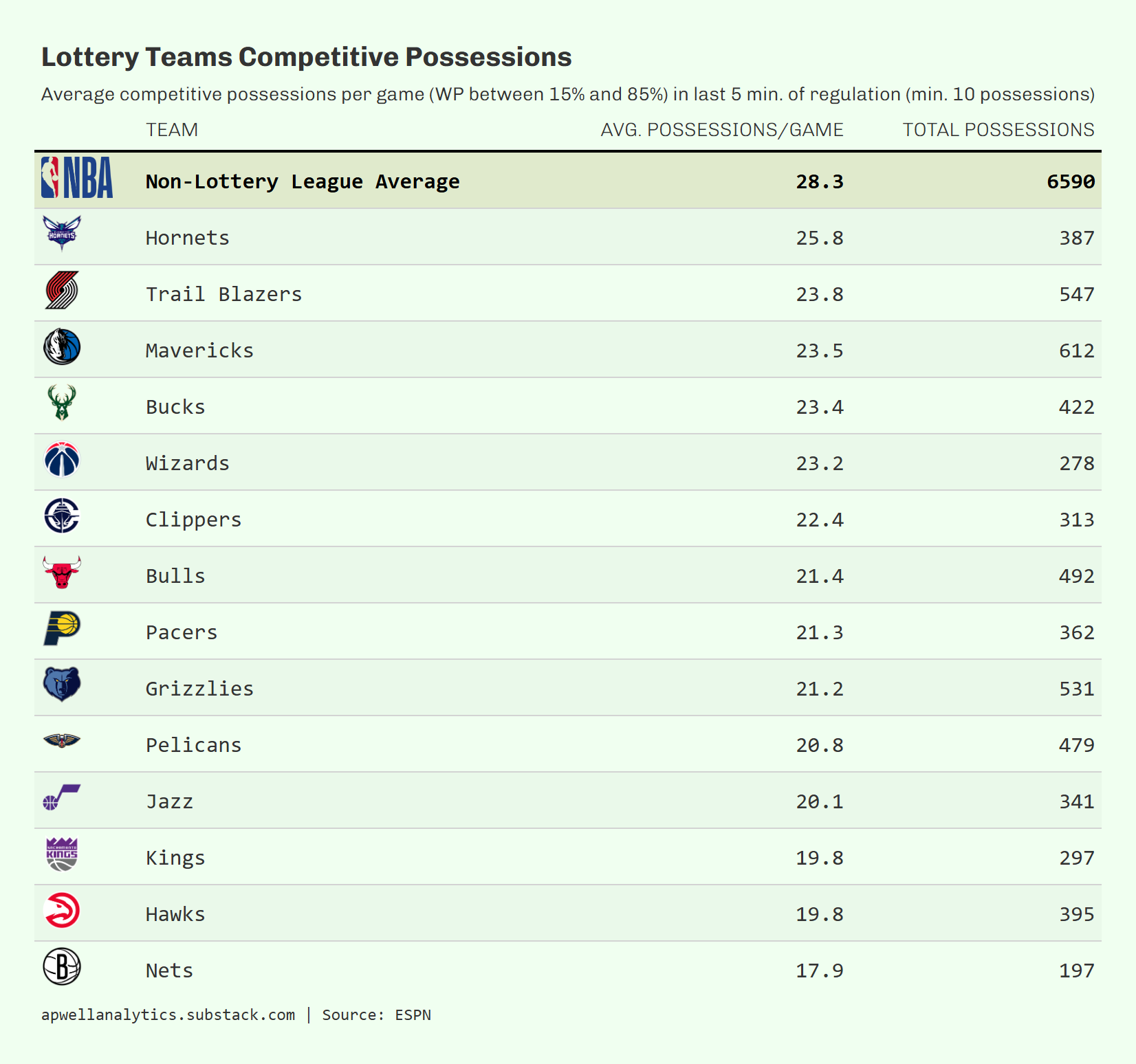
Analyzing lottery teams’ average competitive possessions to other lottery teams and the non-lottery league average helps filter out lottery teams that are actually uncompetitive. The non-lottery teams averaged 28.3 competitive possessions per game.
Giving a slight cushion of 5 possessions per-game to filter the more non-competitive teams, the following teams are left in order of worst average competitive possessions in the last 5 minutes of regulation:
Nets
Hawks
Kings
Jazz
Pelicans
Grizzlies
Pacers
Bulls
Clippers
However, to properly analyze these trends, team context must be provided. Below is the context for each team’s draft picks in 2026 and roster construction:
Brooklyn Nets
The Brooklyn Nets are currently the 5th-worst team in the league, a prime candidate to look into for tanking. Having the worst average competitive possessions per game does not help their case. The Nets are, however, a very young and inexperienced team in the beginning stages of a rebuild. The Nets own their first-round pick in the 2026 draft and just waived one of their primary scorers in recent years, Cam Thomas.
Atlanta Hawks
The Atlanta Hawks are an incomplete roster looking to stay competitive this season while also looking to plan for their future. It is a reasonable approach as the team has decided to move on from Trae Young (and almost everyone they brought in this summer to help him), and the fact that they do not own their first-round pick. A big caveat, however, is that the Hawks get the best first-round pick of the Pelicans and Bucks (both currently lottery teams). Though the Hawks are at the bottom of competitive possessions in late-game scenarios, it is safe to take them out of the potential tanking pool as they do not control their destiny.
Sacramento Kings
The Kings are an underperforming roster with players who have proven they do not work together in previous seasons and teams. The team is comprised of some of the more competitive players in the NBA, but they have not been able to win consistently or produce a competitive product for fans. The Kings do own their 2026 first-round pick and have shut down one of their star players (Zac Lavine) for the season to undergo an injury procedure. The Kings appear to be looking towards the 2026 draft.
New Orleans Pelicans
The New Orleans Pelicans are a bottom team in the NBA and do not own their own pick. The team traded away the rights to their pick swap with the Bucks in 2026 for Derik Queen from Atlanta on draft night in 2025. Though Queen is showing to be a promising young player, they no longer own their 2026 first-round pick, which is likely going to be a top 3 or 4 pick. The Pelicans are forced to invest in their young roster to develop in-season.
Memphis Grizzlies
The Grizzlies (like previous seasons) have been plagued by injuries, most notably to their superstar Ja Morant. Due to their injuries, it is hard to say how good this team really is; however, they have decided to completely undo their core by trading away Jaren Jackson Jr. (following the trade of Desmond Bane in the summer). The Grizzlies own their 2026 first-round pick and appear to be looking toward the future.
Indiana Pacers
The Indiana Pacers are coming off an exciting finals appearance with their star player out for the 2025-2026 season due to an injury he suffered in the finals. Though the general makeup of the team did not change drastically (though they did also lose their starting center in free agency), the team has struggled to find an identity and momentum. The Pacers partially own their first-round pick, as they involved that pick in a trade for Ivica Zubac (their starting center replacement) and Kobe Brown from the Los Angeles Clippers. This trade puts the team in a tricky situation that can backfire, as it is only top 4 and 10-30 protected. If they end up winning enough to land in the 5-9 slot of the lottery, the pick is conveyed to the Los Angeles Clippers.
Chicago Bulls
The Bulls own their first-round pick in 2026 and seem to be fairly competitive throughout their final 5-minute stretches. The Bulls started the year hot and have settled back into mediocrity as the year continued. It should be noted that injuries have been a contributing factor to their play. The sharp decline in win probability in the final seconds of the game, in combination with their relatively competitive win percentage of the proceeding 5 minute stretch hint more at an inability to win close games than deliberately losing games.
Los Angeles Clippers
The Clippers are in a very unusual situation. They started the season with 3 future Hall of Famers and a highly valued center in the league; however, they were one of the worst teams throughout most of the beginning of the season at 6-21. The team is in the midst of a historic turnaround after winning 20 of its last 27 games. There is no debating that they are competing to get out of the lottery. From the win probability plot, the Clippers appear to be capable of providing a competitive late-game basketball. Their sharp decline in the final ~30 seconds of game regulation may be a result of recent roster changes to their core players.
Bonus: Milwaukee Bucks
The Bucks have had an injury-plagued season with their superstar Giannis Antetokounmpo and will receive the least favorable of their and the New Orleans Pelicans first round pick. Given the trade New Orleans acquired for Derek Queen and the design of the lottery system, the Bucks do not control where their pick goes. As a result, the Bucks have no incentive to completely tank. From the win probability plot, they show an upward trend to providing competition, but seem to lack the ability to properly execute throughout the entirety of their final 5-minute stretches.
Rotations
The final aspect in quantifying competition is analyzing who is on the floor for each team. A common trend to make the postseason is to surround your team with enough veteran players to help anchor it. Contrarily, teams that end up tanking (if they own their first round pick) or investing (don’t own their first round pick) play more of their younger players.
The pivotal point in the season is the trade deadline. This year, it occurred a little past the halfway mark of the season. With slightly more than half of the season being complete by the deadline, franchises typically know who they are as a team and what their realistic season goals should be. The front offices make their trade deadline decisions on such assessments and opt to do something similar to the 3 options below:
Invest - Play younger players more to scout for future season personnel with no intention to tank
Pivot - Acquire or trade players to still compete for post-season play
Tank - Do as little as possible to win games (i.e., rest players more on closely scheduled games, schedule season-ending injuries, etc.)
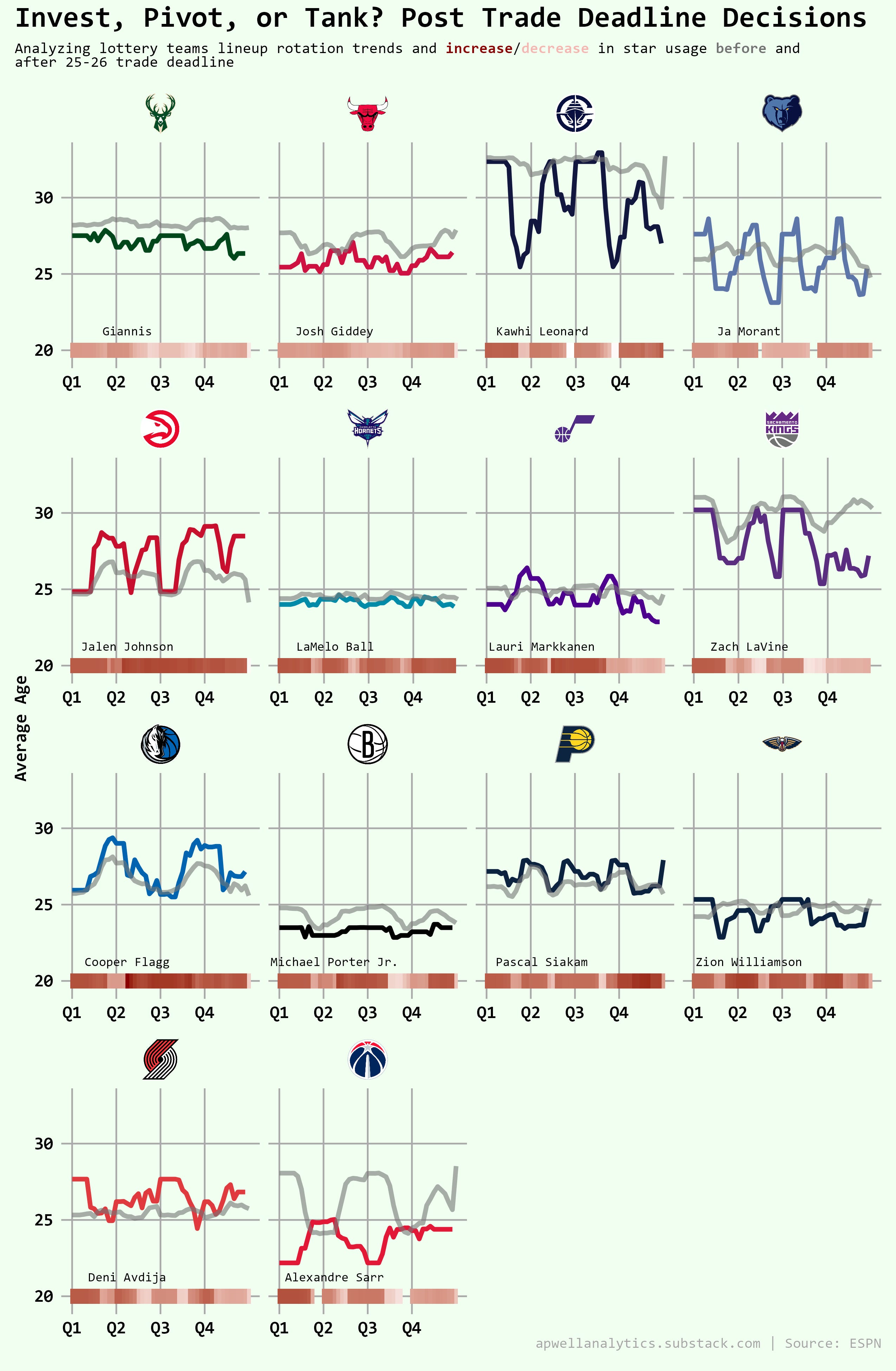
As a result, I looked at each lottery team’s average lineup rotation age throughout their games pre and post-trade deadline, while highlighting their star players’ difference in usage from the deadline. The chart below shows the results.
With the context laid out earlier for some of the lottery teams, I was able to categorize the teams into the following categories:
Invest
Charlotte Hornets
Dallas Mavericks
New Orleans Pelicans
Chicago Bulls
Pivot
Atlanta Hawks
Los Angeles Clippers
Milwaukee Bucks
Memphis Grizzlies
Indiana Pacers
Trail Blazers
Tank Radar
Utah Jazz
Brooklyn Nets
Washington Wizards
Sacramento Kings
The reasoning for the 4 teams identified as in on the Tank Radar is given below. It should be noted that one of the criteria to be in this category was for the team to own their first round pick in next year’s draft.
Washington Wizards
The Wizards are here for a few reasons. As shown in the first two plots, they largely hold a below 50% win probability for the last 5 min of regulation through the season so far. In addition, they hold the 2nd least amount of competitive possession in that 5 min stretch (though they rank 5th in lottery teams in average win probability due to the small sample size). The Wizards also made major trades going into the trade deadline, but it is rumored that the acquired players will play very little for the remainder of the season. With their lineup rotations getting significantly younger and their questionable withholding of former all-star Trae Young and Top 75, 1.5-year-removed Olympian Anthony Davis, the Wizards are giving signs they are intending to tank this year.
Brooklyn Nets
The Brooklyn Nets are at (or near) the bottom of every competition metric highlighted in this article. Alongside a poorly constructed roster and the waiving of one of their primary scorers for the past couple of seasons, the Nets have not shown any intention of looking to increase their wins.
Sacramento Kings
It could be said that the Sacramento Kings were actually trying to compete this year, but just did not have the roster to do it. With their inability to hold competitive possessions late in technically still winnable games, no significant roster changes at the trade deadline, and their average lineup age falling off significantly post trade deadline (which should continue with the season ending surgery for Zach LaVine), the Kings are a prime candidate to consider as a tanking team.
Utah Jazz
The Jazz are the most obvious tanking team. Though they have a young team in the midst of their rebuild weighing down the rotations’ age, and have made trades to acquire a proven player in Jaren Jackson Jr., they are the lone team holding out their star player in multiple games for non-injury reasons. The heatmap for the Utah Jazz in the “Invest, Pivot, or Tank? Post Trade Deadline Decisions” plot shows that post trade deadline, the Jazz are not playing the player that gives them the best chance to win for most of the 4th quarter. This is why they got fined. Not to mention, they shut down Jaren Jackson Jr. for the rest of the season after getting fined for not playing him along with Lauri Markkanen in the 4th quarter.
Borderline Tanker: Indiana Pacers
While I have the Pacers as a team looking to pivot mainly due to the acquisition of Ivica Zubac, it should be noted that they are in an interesting area where they, on paper, shouldn’t be as bad as they are. As a result, they could start winning more games (especially with the addition of Zubac) with their talent and the right adjustments. However, to keep their first-round pick, they have to avoid landing in the 5-9 draft slot. The benching of Pascal Siakam, resulting in a fine from the NBA, could have been an early warning to prevent them from trying to better their odds down the road.
Conclusion
The tanking dilemma is hard to regulate from a league perspective and has caused a new conversation around how the draft and teams’ picks should be handled. Through similar exploratory analysis and observable context, tanking flags can be identified by interested parties. It will be interesting to see how the league interacts with its teams for the remainder of the season and what adjustments lottery contending teams make.